Thursday, 18 February 2010

U.N. Climate Chief Resigns

source: New York Times
by: John M Broder

WASHINGTON — Yvo de Boer, the stolid Dutch bureaucrat who led the international climate change negotiations over four tumultuous years, is resigning his post as of July 1, the United Nations said on Thursday.


In a statement announcing his departure, Mr. de Boer expressed disappointment that the December climate change conference of nearly 200 nations in Copenhagen had failed to produce an enforceable agreement to reduce emissions of greenhouse gases that climate scientists say are contributing to the warming of the planet.

He also said that governmental negotiations could provide a framework for action on climate, but that the solutions must come from the businesses that produce and consume the fuels that add to global warming.

“Copenhagen did not provide us with a clear agreement in legal terms, but the political commitment and sense of direction toward a low-emissions world are overwhelming,” said Mr. de Boer, whose formal title is executive secretary of the United Nations Framework Convention on Climate Change. “This calls for new partnerships with the business sector, and I now have the chance to help make this happen.”

Mr. de Boer, 55, will join the consulting group KPMG as global adviser on climate and sustainability and will also work in academia, his office said.

Those who worked with Mr. de Boer were not completely surprised by his resignation. He was known to be exhausted and frustrated by the task of trying to bring together developed and developing nations with widely divergent interests to address a global problem that he believed threatened the planet’s health. But the timing was somewhat unexpected.

Mr. de Boer will be leaving his post a few months before nations meet again under United Nations auspices in CancĂșn, Mexico, to try to move toward an enforceable global climate treaty.

The Copenhagen conference left all the parties frustrated, and none more so than Mr. de Boer, who had traveled incessantly for four years trying to prod nations to produce a treaty by the end of 2009. In an interview with The Associated Press in Amsterdam on Thursday, he said that the high point of his tenure was the agreement in Bali at the end of 2007 under which nations agreed to a December 2009 deadline to produce a worldwide treaty on global warming.

That treaty was to have been signed at Copenhagen, which produced instead a much weaker political agreement after nearly two weeks of bitter and largely fruitless argument.

Mr. de Boer highlighted the concrete achievements of the Copenhagen meeting, a statement by the parties that global temperatures should rise no more than 2 degrees Celsius above pre-industrial levels and pledges by nearly 100 nations to take steps to reduce greenhouse gas emissions by 2020.

“Countries responsible for 80 percent of energy-related CO2 emissions have submitted national plans and targets to address the climate change,” he said. “This underlines their commitment to meet the challenge of climate change and work toward an agreed outcome in Cancun.”

Before joining the United Nations climate secretariat, Mr. de Boer was deputy director general of the Dutch environment ministry, vice chairman of the United Nations Commission on Sustainable Development and an adviser to the World Bank and the Chinese government.

His successor is expected to be named in the next few months.

Wednesday, 17 February 2010

Latest List of the Global Warming Cult’s Lies

source: Bobs Bites
by: Robert D

Finally, a list of the latest lies from the Global warming cult. The wheels continue to come off the “Climate Change” bus.

ClimateGate – This scandal began the latest round of revelations when thousands of leaked documents from Britain’s East Anglia Climate Research Unit showed systematic suppression and discrediting of climate skeptics’ views and discarding of temperature data, suggesting a bias for making the case for warming. Why do such a thing if, as global warming defenders contend, the “science is settled?”

FOIGate – The British government has since determined someone at East Anglia committed a crime by refusing to release global warming documents sought in 95 Freedom of Information Act requests. The CRU is one of three international agencies compiling global temperature data. If their stuff’s so solid, why the secrecy?

ChinaGate – An investigation by the U.K.’s left-leaning Guardian newspaper found evidence that Chinese weather station measurements not only were seriously flawed, but couldn’t be located. “Where exactly are 42 weather monitoring stations in remote parts of rural China?” the paper asked. The paper’s investigation also couldn’t find corroboration of what Chinese scientists turned over to American scientists, leaving unanswered, “how much of the warming seen in recent decades is due to the local effects of spreading cities, rather than global warming?” The Guardian contends that researchers covered up the missing data for years.


HimalayaGate – An Indian climate official admitted in January that, as lead author of the IPCC’s Asian report, he intentionally exaggerated when claiming Himalayan glaciers would melt away by 2035 in order to prod governments into action. This fraudulent claim was not based on scientific research or peer-reviewed. Instead it was originally advanced by a researcher, since hired by a global warming research organization, who later admitted it was “speculation” lifted from a popular magazine. This political, not scientific, motivation at least got some researcher funded.

PachauriGate – Rajendra Pachauri, the IPCC chairman who accepted with Al Gore the Nobel Prize for scaring people witless, at first defended the Himalaya melting scenario. Critics, he said, practiced “voodoo science.” After the melting-scam perpetrator ‘fessed up, Pachauri admitted to making a mistake. But, he insisted, we still should trust him.

PachauriGate II – Pachauri also claimed he didn’t know before the 192-nation climate summit meeting in Copenhagen in December that the bogus Himalayan glacier claim was sheer speculation. But the London Times reported that a prominent science journalist said he had pointed out those errors in several e-mails and discussions to Pachauri, who “decided to overlook it.” Stonewalling? Cover up? Pachauri says he was “preoccupied.” Well, no sense spoiling the Copenhagen party, where countries like Pachauri’s India hoped to wrench billions from countries like the United States to combat global warming’s melting glaciers. Now there are calls for Pachauri’s resignation.

SternGate – One excuse for imposing worldwide climate crackdown has been the U.K.’s 2006 Stern Report, an economic doomsday prediction commissioned by the government. Now the U.K. Telegraph reports that quietly after publication “some of these predictions had been watered down because the scientific evidence on which they were based could not be verified.” Among original claims now deleted were that northwest Australia has had stronger typhoons in recent decades, and that southern Australia lost rainfall because of rising ocean temperatures. Exaggerated claims get headlines. Later, news reporters disclose the truth. Why is that?

SternGate II – A researcher now claims the Stern Report misquoted his work to suggest a firm link between global warming and more-frequent and severe floods and hurricanes. Robert Muir-Wood said his original research showed no such link. He accused Stern of “going far beyond what was an acceptable extrapolation of the evidence.” We’re shocked.

AmazonGate – The London Times exposed another shocker: the IPCC claim that global warming will wipe out rain forests was fraudulent, yet advanced as “peer-reveiwed” science. The Times said the assertion actually “was based on an unsubstantiated claim by green campaigners who had little scientific expertise,” “authored by two green activists” and lifted from a report from the World Wildlife Fund, an environmental pressure group. The “research” was based on a popular science magazine report that didn’t bother to assess rainfall. Instead, it looked at the impact of logging and burning. The original report suggested “up to 40 percent” of Brazilian rain forest was extremely sensitive to small reductions in the amount of rainfall, but the IPCC expanded that to cover the entire Amazon, the Times reported.

PeerReviewGate – The U.K. Sunday Telegraph has documented at least 16 nonpeer-reviewed reports (so far) from the advocacy group World Wildlife Fund that were used in the IPCC’s climate change bible, which calls for capping manmade greenhouse gases.

RussiaGate – Even when global warming alarmists base claims on scientific measurements, they’ve often had their finger on the scale. Russian think tank investigators evaluated thousands of documents and e-mails leaked from the East Anglia research center and concluded readings from the coldest regions of their nation had been omitted, driving average temperatures up about half a degree.

Russia-Gate II – Speaking of Russia, a presentation last October to the Geological Society of America showed how tree-ring data from Russia indicated cooling after 1961, but was deceptively truncated and only artfully discussed in IPCC publications. Well, at least the tree-ring data made it into the IPCC report, albeit disguised and misrepresented.

U.S.Gate – If Brits can’t be trusted, are Yanks more reliable? The U.S. National Climate Data Center has been manipulating weather data too, say computer expert E. Michael Smith and meteorologist Joesph D’Aleo. Forty years ago there were 6,000 surface-temperature measuring stations, but only 1,500 by 1990, which coincides with what global warming alarmists say was a record temperature increase. Most of the deleted stations were in colder regions, just as in the Russian case, resulting in misleading higher average temperatures.

IceGate – Hardly a continent has escaped global warming skewing. The IPCC based its findings of reductions in mountain ice in the Andes, Alps and in Africa on a feature story of climbers’ anecdotes in a popular mountaineering magazine, and a dissertation by a Switzerland university student, quoting mountain guides. Peer-reviewed? Hype? Worse?

ResearchGate – The global warming camp is reeling so much lately it must have seemed like a major victory when a Penn State University inquiry into climate scientist Michael Mann found no misconduct regarding three accusations of climate research impropriety. But the university did find “further investigation is warranted” to determine whether Mann engaged in actions that “seriously deviated from accepted practices for proposing, conducting or reporting research or other scholarly activities.” Being investigated for only one fraud is a global warming victory these days.

ReefGate – Let’s not forget the alleged link between climate change and coral reef degradation. The IPCC cited not peer-reviewed literature, but advocacy articles by Greenpeace, the publicity-hungry advocacy group, as its sole source for this claim.

AfricaGate – The IPCC claim that rising temperatures could cut in half agricultural yields in African countries turns out to have come from a 2003 paper published by a Canadian environmental think tank – not a peer-reviewed scientific journal.

DutchGate – The IPCC also claimed rising sea levels endanger the 55 percent of the Netherlands it says is below sea level. The portion of the Netherlands below sea level actually is 20 percent. The Dutch environment minister said she will no longer tolerate climate researchers’ errors.

AlaskaGate – Geologists for Space Studies in Geophysics and Oceanography and their U.S. and Canadian colleagues say previous studies largely overestimated by 40 percent Alaskan glacier loss for 40 years. This flawed data are fed into those computers to predict future warming.

Monday, 15 February 2010

Climategate U-turn as scientist at centre of row admits: There has been no global warming since 1995

source: dailymail.co.uk
by: Jonathan Petre

  • Data for vital 'hockey stick graph' has gone missing
  • There has been no global warming since 1995
  • Warming periods have happened before - but NOT due to man-made changes

Data: Professor Phil Jones admitted his record keeping is 'not as good as it should be'
The academic at the centre of the ‘Climategate’ affair, whose raw data is crucial to the theory of climate change, has admitted that he has trouble ‘keeping track’ of the information.

Colleagues say that the reason Professor Phil Jones has refused Freedom of Information requests is that he may have actually lost the relevant papers.

Professor Jones told the BBC yesterday there was truth in the observations of colleagues that he lacked organisational skills, that his office was swamped with piles of paper and that his record keeping is ‘not as good as it should be’.


The data is crucial to the famous ‘hockey stick graph’ used by climate change advocates to support the theory.
Professor Jones also conceded the possibility that the world was warmer in medieval times than now – suggesting global warming may not be a man-made phenomenon.

And he said that for the past 15 years there has been no ‘statistically significant’ warming.

The admissions will be seized on by sceptics as fresh evidence that there are serious flaws at the heart of the science of climate change and the orthodoxy that recent rises in temperature are largely man-made.

Professor Jones has been in the spotlight since he stepped down as director of the University of East Anglia’s Climatic Research Unit after the leaking of emails that sceptics claim show scientists were manipulating data.

The raw data, collected from hundreds of weather stations around the world and analysed by his unit, has been used for years to bolster efforts by the United Nation’s Intergovernmental Panel on Climate Change to press governments to cut carbon dioxide emissions.

Following the leak of the emails, Professor Jones has been accused of ‘scientific fraud’ for allegedly deliberately suppressing information and refusing to share vital data with critics.

Discussing the interview, the BBC’s environmental analyst Roger Harrabin said he had spoken to colleagues of Professor Jones who had told him that his strengths included integrity and doggedness but not record-keeping and office tidying.

Mr Harrabin, who conducted the interview for the BBC’s website, said the professor had been collating tens of thousands of pieces of data from around the world to produce a coherent record of temperature change.

That material has been used to produce the ‘hockey stick graph’ which is relatively flat for centuries before rising steeply in recent decades.

According to Mr Harrabin, colleagues of Professor Jones said ‘his office is piled high with paper, fragments from over the years, tens of thousands of pieces of paper, and they suspect what happened was he took in the raw data to a central database and then let the pieces of paper go because he never realised that 20 years later he would be held to account over them’.

Asked by Mr Harrabin about these issues, Professor Jones admitted the lack of organisation in the system had contributed to his reluctance to share data with critics, which he regretted.


But he denied he had cheated over the data or unfairly influenced the scientific process, and said he still believed recent temperature rises were predominantly man-made.

Asked about whether he lost track of data, Professor Jones said: ‘There is some truth in that. We do have a trail of where the weather stations have come from but it’s probably not as good as it should be.

‘There’s a continual updating of the dataset. Keeping track of everything is difficult. Some countries will do lots of checking on their data then issue improved data, so it can be very difficult. We have improved but we have to improve more.’

He also agreed that there had been two periods which experienced similar warming, from 1910 to 1940 and from 1975 to 1998, but said these could be explained by natural phenomena whereas more recent warming could not. 

He further admitted that in the last 15 years there had been no ‘statistically significant’ warming, although he argued this was a blip rather than the long-term trend.

And he said that the debate over whether the world could have been even warmer than now during the medieval period, when there is evidence of high temperatures in northern countries, was far from settled.

Sceptics believe there is strong evidence that the world was warmer between about 800 and 1300 AD than now because of evidence of high temperatures in northern countries.

But climate change advocates have dismissed this as false or only applying to the northern part of the world.

Professor Jones departed from this consensus when he said: ‘There is much debate over whether the Medieval Warm Period was global in extent or not.

The MWP is most clearly expressed in parts of North America, the North Atlantic and Europe and parts of Asia.

‘For it to be global in extent, the MWP would need to be seen clearly in more records from the tropical regions and the Southern hemisphere. There are very few palaeoclimatic records for these latter two regions.

‘Of course, if the MWP was shown to be global in extent and as warm or warmer than today, then obviously the late 20th Century warmth would not be unprecedented. On the other hand, if the MWP was global, but was less warm than today, then the current warmth would be unprecedented.’

Sceptics said this was the first time a senior scientist working with the IPCC had admitted to the possibility that the Medieval Warming Period could have been global, and therefore the world could have been hotter then than now.

Professor Jones criticised those who complained he had not shared his data with them, saying they could always collate their own from publicly available material in the US. And he said the climate had not cooled ‘until recently – and then barely at all. The trend is a warming trend’.

Mr Harrabin told Radio 4’s Today programme that, despite the controversies, there still appeared to be no fundamental flaws in the majority scientific view that climate change was largely man-made.

But Dr Benny Pieser, director of the sceptical Global Warming Policy Foundation, said Professor Jones’s ‘excuses’ for his failure to share data were hollow as he had shared it with colleagues and ‘mates’.

He said that until all the data was released, sceptics could not test it to see if it supported the conclusions claimed by climate change advocates.

He added that the professor’s concessions over medieval warming were ‘significant’ because they were his first public admission that the science was not settled.

Friday, 12 February 2010

NASA Launches Satellite to Watch for Solar Storms

source: Reuters
by: Jane Sutton

CAPE CANAVERAL, Fla., Feb 11 (Reuters) - NASA launched a science satellite on Thursday to keep a close watch on the sun and help improve forecasts of the solar storms that can disrupt navigational signals, satellites and power grids.


The Solar Dynamics Observatory, or SDO, lifted off aboard an unmanned Atlas 5 rocket, made by United Launch Alliance, at 10:23 a.m. EST (1523 GMT) from Cape Canaveral Air Force Station in Florida, following a one-day delay due to poor weather.

The alliance is a joint venture between Boeing Co (BA.N) and Lockheed Martin Corp (LMT.N).

From an orbital perch 22,300 miles (35,680 km) above Earth, the solar observatory is to spend the next five to 10 years watching the sun, relaying extremely high-resolution data and live imagery.

With no onboard recorders, NASA is expecting about 1.5 terabytes of data daily from SDO, enough to fill one compact disc about every 36 seconds.

"SDO is going to send us images 10 times better than high definition," project scientist Dean Pesnell said. "The pixel count is comparable to an IMAX movie -- an IMAX filled with the raging sun, 24 hours a day."

Solar physicists expect to use the information to improve predictions of solar flares and geomagnetic storms, which can disrupt GPS navigational signals, disable satellites and knock out power grids. Space weather also affects airlines, which have to reroute flights over Earth's poles due to radio interference.

"Two or three days' lead time can make the difference between safeguarding the advanced technologies we depend on every day and the catastrophic loss of these capabilities and trillions of dollars in disrupted commerce," Thomas Bogdan, director of the National Oceanic and Atmospheric Administration's Space Weather Prediction Center in Boulder, Colorado, said in a statement.

"The goal is to develop a real physical understanding of what goes on so we can make more sophisticated predictions," added Alan Title, lead scientist for one of SDO's three instruments.

NASA, which is spending about $858 million on the mission, also plans to use SDO's data in an iPhone application called "3D Sun" which will display continuous three-dimensional views of the sun.

Thursday, 11 February 2010

Australiagate: Now NASA Caught in Trick Over Aussie Climate Data

source: Prison Planet
by: John O'Sullivan

In this article we look at the findings of two independent climate researchers who analyse climatic data used by the Intergovernmental Panel on Climate Change (IPCC) to show warming of two degrees per century for Australia without explanation. We find that an earlier study by Willis Eschenbach in an article on What’s up with That (WUWT) is wholly substantiated by Kens Kingdom’slatest analysis of Ken Stewart at his ‘kenskingdom’ blog. As a consequence, absent any other justification from NASA, we must conclude that the NASA data has been fraudulently cooked.

GISS, based at Columbia University in New York City, has adjusted over a century’s worth of temperature records from the vast Queensland State (the Sunshine State) to reverse a cooling trend in one ground weather station and increase a warming trend in another to skew the overall data set.
Independent analysis by Aussie blogger Ken Stewart exposes a deplorable smoking gun of cynical manipulation of raw temperature data.

The process of adjusting raw data to create a “homogenised” final global temperature chart is standard practice by climatologists whose work is relied upon by the Intergovernmental Panel on Climate Change (IPCC) and world governments. This homogenisation process of temperature data has fallen into disrepute since the Climategate scandal where scientists were proven to have unlawfully used a “trick” to fake climate data and then destroyed their calculations rendering it impossible for independent auditors to examine and justify the methodologies used.

Ken Stewart has his own take on these latest findings from Down Under: “Wow- when they adjust, they don’t muck around!”

GISS combines GHCN data from all urban stations applying the same inexplicable two degree temperature increase as shown below to reveal the shocking disparity between ‘raw’ data and the ‘cooked’ GISS data:

Ken proves that the GISS homogenised older data to make the climate appear cooler a hundred years ago and then ramped up modern data to artificially make recent years appear warmer. Thus climate scientists have artificially created a steep trend line to falsely give an impression of a 2 degrees rise in Australian temperatures over a 100 year period. Ken found that if climatologists had stuck to the raw data the trendline would have been as low as 0.2 degrees per 100 years – thus the overall temperature rise has been magnified by a factor of ten for no apparent reason other than to cause alarm.

Ken explains how he undertook his research,
I decided to have a look at the temperature records of the weather stations closest to where I live, near Mackay in North Queensland. The Bureau of Meteorology lists 3 current stations: Mackay MO, Mackay Aero, and Te Kowai Exp Station, plus the closed station Mackay Post Office. GISS has a list of nearby stations… Te Kowai is an experimental farm for developing new varieties of sugar cane, run by scientists and technicians since 1889. It has a temperature record of over 100 years with only a couple of gaps. So in fact it’s an ideal rural station for referencing a nearby urban station, as it should have a similar climate.

Ken found that the “Mackay Sugar Mill Station” was far hotter in the 1920’s and 30’s but GISS “disappeared” this data. However, if we add the warming period back in we find that the warming trend almost disappears to become less then 0.2 degrees per 100 years!

Ken concludes, “How can GISS justify their manipulation of the data, which they claim not to do?”

Upon closer examination of GISS methodology it appears that accidentally on purpose they used a “trick” whereby they turned “Mackay Sugar Mill Station” into a small town rather than a rural station even though it’s been nothing much more than cane fields for the last 130 years. There are different procedures applied to homogenising data between urban and rural weather stations.

I have examined Ken’s findings and can concur with him that there exists inexplicable anomalies that, without exception, appear concocted (homogenized) to create a warming trend when no evidence in changes in the local environmental conditions warrants any such manipulation. Moreover, GISS does not publish any explanations of why they chose to make cooler those temperatures in the first 40 years of their sample and then ramp up the temperatures for recent years. Absent any explanation from them, we may draw our own conclusions that the GISS lowered the older temperature records and raised the temperatures of recent years to create a fictitiously steeper homogenised warming slope to fit a pre-conceived warmist agenda.

Ken says this is fraud, “And it’s happening in my own backyard! I’m furious!”

This finding, when compared to those from other independent observers shows further attempts by government and government-funded agencies to fraudulent create a man made warming signal in Australia from natural events and data.

Ken’s findings tie in really well with the anomaly exposed by WUWT where Willis Eschenbach found similar dodgy data for Darwin, in the Northern Territory ( a vast Aussie state of 1,349,129 square kilometres (520,902 sq mi):
Here is Eschenbach’s comment on the data about Darwin:
YIKES! Before getting homogenized, temperatures in Darwin were falling at 0.7 Celcius per century … but after the homogenization, they were warming at 1.2 Celcius per century. And the adjustment that they made was over two degrees per century … when those guys “adjust”, they don’t mess around. And the adjustment is an odd shape, with the adjustment first going stepwise, then climbing roughly to stop at 2.4C.

The similarities in degree and extent of fakery found separately by Eschenbach and Stewart proves a consistent fraudulent objective: make older temperatures appear artificially cooler and exagerrate recent temperature data.

Climategate.com has built up a close affinity with Australian skeptics who have worked tirelessly to expose the climate scam still being brainlessly plugged by Aussie Prime Minister, Kevin Rudd. Further similar contributions submitted to us for publication are most welcome. We intend to continue to expose such fraud relying on the technical and analytical skills of gifted amateur bloggers to fully expose the greatest scam in the history of science. Our aim is to bring forth criminal and civil proceedings against all those involved.

Monday, 8 February 2010

Top British Scientist Says UN Panel is Losing Credibility

source: Times Online
by: Jonathan Leake, Environment Editor

A LEADING British government scientist has warned the United Nations’ climate panel to tackle its blunders or lose all credibility.

Robert Watson, chief scientist at Defra, the environment ministry, who chaired the Intergovernmental Panel on Climate Change (IPCC) from 1997 to 2002, was speaking after more potential inaccuracies emerged in the IPCC’s 2007 benchmark report on global warming.

The most important is a claim that global warming could cut rain-fed north African crop production by up to 50% by 2020, a remarkably short time for such a dramatic change. The claim has been quoted in speeches by Rajendra Pachauri, the IPCC chairman, and by Ban Ki-moon, the UN secretary-general.


This weekend Professor Chris Field, the new lead author of the IPCC’s climate impacts team, told The Sunday Times that he could find nothing in the report to support the claim. The revelation follows the IPCC’s retraction of a claim that the Himalayan glaciers might all melt by 2035.

This report is the IPCC’s most politically sensitive publication, distilling its most important science into a form accessible to politicians and policy makers. Its lead authors include Pachauri himself.

In it he wrote: “By 2020, in some countries, yields from rain-fed agriculture could be reduced by up to 50%. Agricultural production, including access to food, in many African countries is projected to be severely compromised.” The same claims have since been cited in speeches to world leaders by Pachauri and Ban.

Speaking at the 2008 global climate talks in Poznan, Poland, Pachauri said: “In some countries of Africa, yields from rain-fed agriculture could be reduced by 50% by 2020.” In a speech last July, Ban said: “Yields from rain-fed agriculture could fall by half in some African countries over the next 10 years.”

Speaking this weekend, Field said: “I was not an author on the Synthesis Report but on reading it I cannot find support for the statement about African crop yield declines.”

Watson said such claims should be based on hard evidence. “Any such projection should be based on peer-reviewed literature from computer modelling of how agricultural yields would respond to climate change. I can see no such data supporting the IPCC report,” he said.

The claims in the Synthesis Report go back to the IPCC’s report on the global impacts of climate change. It warns that all Africa faces a long-term threat from farmland turning to desert and then says of north Africa, “additional risks that could be exacerbated by climate change include greater erosion, deficiencies in yields from rain-fed agriculture of up to 50% during the 2000-20 period, and reductions in crop growth period (Agoumi, 2003)”.

“Agoumi” refers to a 2003 policy paper written for the International Institute for Sustainable Development, a Canadian think tank. The paper was not peer-reviewed.

Its author was Professor Ali Agoumi, a Moroccan climate expert who looked at the potential impacts of climate change on Tunisia, Morocco and Algeria. His report refers to the risk of “deficient yields from rain-based agriculture of up to 50% during the 2000–20 period”.

These claims refer to other reports prepared by civil servants in each of the three countries as submissions to the UN. These do not appear to have been peer-reviewed either.

The IPCC is also facing criticism over its reports on how sea level rise might affect Holland. Dutch ministers have demanded that it correct a claim that more than half of the Netherlands lies below sea level when, in reality, it is about a quarter.

The errors seem likely to bring about change at the IPCC. Field said: “The IPCC needs to investigate a more sophisticated approach for dealing with emerging errors.”

Monday, 1 February 2010

Bohai China: The Highest Volume of Sea Ice in Three Decades

source: China Daily

Shipping, fish farming hit by worst freeze in three decades


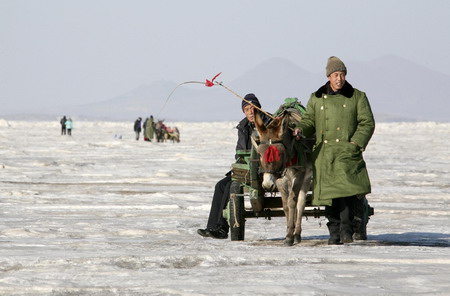
There is no need for fishermen to chain their boats to the shores of Juhua Island; they have all been frozen firmly to the spot since the Bohai Bay turned into a massive ice rink.


From the beach, the seascape is a glistening, unmoving block that has become impossible for ferries to navigate. Tricycle riders are the only ones brave enough to transport residents across the 7.5-km of ice that separates the island from Xingcheng, the closest city on the mainland in Liaoning province.

Some locals are even resorting to pao bing, running on ice, to fetch vital daily necessities.
"The ice is very thick this year so there is no danger of falling through," said fisherman Liu Ping, 42, as he paid 50 yuan ($7) for a tricycle ride. "I urgently need to make an appointment with a boat repairer in Xingcheng. If I don't, all the good ones will be fully booked by the time the ice melts in the spring."

The island's 3,200 residents have been cut off from the mainland since Jan 5 when the ice became too thick for boats to pass through. As it is hard to judge the depth of the ice, the local government banned pao bing and set up special patrols to prevent it. But people are still taking the risk.

Some residents in Sichengzi village use small electric tricycles to make runs to Xingcheng every morning and afternoon, charging passengers up to 100 yuan one way in severe weather.

A "safe" route has already taken shape on the ice and, watching from the shore, tricycles can be seen weaving in and out as they shuttle commuters along the well-used track. The riders know they are risking their lives for extra income so they often ride cautiously. "It takes me one hour to travel 5 km," complained a passenger surnamed Liu.

The highest volume of sea ice in three decades has affected fish farming, sea transportation and offshore oil drilling.

Those living on Juhua Island, the largest in the gulf, are no strangers to the situation. Bohai freezes every year and villagers are usually prepared. "The island has a long history and we have become used to life in winter, so in autumn we start storing rice, meat, vegetables and other necessities," said Liu.

Ships carrying food and other supplies were also able to reach the island on Jan 21, thanks to help from an icebreaker.

The biggest concern for islanders is medical treatment, said Huai Lixing, a local hotel manager.

"The island has only one hospital, although it is more like a village healthcare clinic," he said. "The doctors there cannot do a simple procedure like an appendectomy, let alone deal with a big problem. So anyone needing emergency treatment has no option but to pao bing.

"What we really need is a bridge to be built to the mainland, but that takes money and no one wants to invest."